Castelloria: A Serif Font Blending Classic Roots with Modern Edge
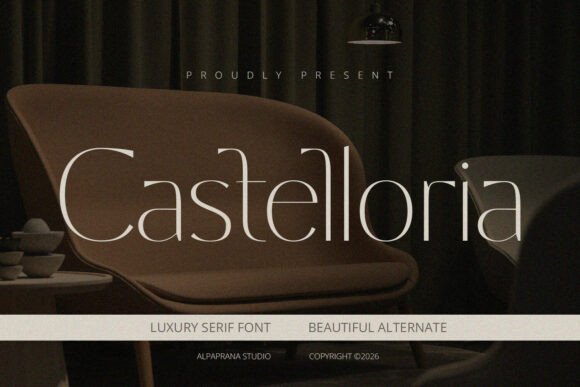
When you're building a brand or crafting a design that needs to feel both established and fresh, the font you choose carries enormous weight. It’s not just about picking letters that look good; it’s about finding a typeface that speaks the right language without shouting. That’s where a font like Castelloria comes into the conversation. It’s a serif font, but it doesn’t feel stuffy or overly traditional. Instead, it brings a modern sensibility to the classic serif structure, offering a unique balance that’s hard to find.
Think about the last time you saw a logo or a magazine headline that felt instantly trustworthy yet contemporary. Chances are, the designer used a font that bridged that exact gap. Castelloria aims to be that bridge. Its letterforms have the sturdy, recognizable features of a serif—the small strokes at the ends of characters that guide the eye and add a touch of formality. But the proportions are cleaner, the details are sharper, and the overall vibe is more streamlined. This isn’t a font that wants to look like it was carved in stone a century ago. It wants to feel relevant today.
Where Modern Serifs Like Castelloria Truly Shine
The real test of any premium font is how it performs across different projects. A beautiful typeface in a specimen sheet can fall flat when applied to a real-world design. Castelloria, however, seems built for application. Its modern serif style makes it surprisingly versatile.
For branding and logo design, it offers instant credibility with a twist. A boutique hotel, a high-end skincare line, or a consulting firm could use Castelloria in their logo to project stability and sophistication without feeling outdated. It’s excellent for logotype work where the name itself needs to carry the brand’s visual identity. Because it’s a display font at heart, it commands attention in headlines, making it perfect for poster designs, magazine covers, and book covers. Imagine a thriller novel cover or a food magazine header set in Castelloria—it has the presence to draw you in.
Beyond large-scale print, think about packaging design. A font needs to be legible on a shopping bag, a box, or a label, but it also needs to convey the product’s quality. Castelloria’s clear letterforms work well here. It can elevate the look of clothing tags, t-shirts for a minimalist brand, or shopping bags for a retail store. For lettering projects, where custom text is key, its alternates and ligatures (more on those later) give designers tools to create something unique.
Practical Guidance for Using This Typeface
Choosing a font is a practical decision. You need to ask: does this work for my project and my audience? Here’s how to evaluate Castelloria.
Evaluate the Personality: Does your project call for a blend of tradition and modernity? If you’re designing for a law firm that wants to seem approachable yet expert, or a tech startup that values heritage, Castelloria could fit. If you need something ultra-minimalist or purely playful, it might not be the first choice. Test it by setting your key headline or logo text and seeing if the tone matches your intent.
Consider Readability and Hierarchy: As a serif, Castelloria is generally easier to read in longer blocks of text than a stark sans-serif, especially in print. However, its modern styling means it’s optimized for impact at larger sizes. Use it for headlines, subheadings, and key statements. For body text, especially on screens, you might pair it with a simple, highly readable sans serif font to create a clear visual hierarchy. This is where font pairing becomes crucial. Castelloria’s strong personality means it often works best with a neutral companion.
Leverage the Included Styles: The font package includes uppercase and lowercase letters, numerals, punctuation, and multilingual accents—essential for professional work. The real gems are the ligatures and alternative style stylistic set. Ligatures connect certain letter pairs (like ‘fi’ or ‘fl’) for smoother flow. The stylistic alternates offer different versions of specific letters, allowing you to customize the look. Do you want a more traditional ‘a’ or a more modern one? Play with these in your design software to refine the character of your text.
Test Across Mediums: A font can look different on a printed poster versus a website or a social media graphic. Castelloria is provided in OTF, TTF, and WOFF formats, covering most bases for desktop use and basic web implementation. Test it in your specific context. How does it render on a dark background for a social media graphics post? Is it clear enough for a small line of text on a product label? Always do a practical test.
Understand the License: This is a commercial font. That means for any project that generates revenue—client work, products for sale, monetized websites—you need to ensure your license covers that use. Read the details. It’s a fundamental part of using design assets professionally and protects both you and the font creator.
In the end, a font like Castelloria is a tool. Its value isn’t just in its aesthetic appeal but in how effectively it communicates your message and supports your brand identity. It’s for designers, entrepreneurs, and creators who need a reliable, stylish serif that doesn’t feel like a cliché. By understanding its strengths—its modern serif style, its versatile applications, and its feature set—you can decide if it’s the right tool to help build your next project with clarity and distinction.